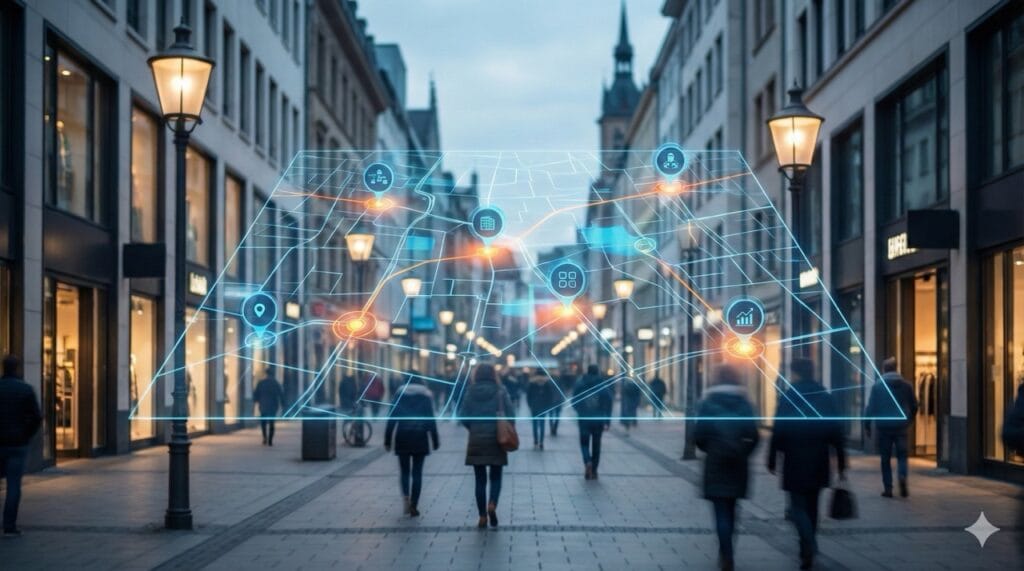

The old retail adage goes: Location, location, location. But what does a ‘good location’ really mean in a world where consumers have already digitally determined their route, destination and purchase before they even step out the door?
We live in an era where consumers don’t just walk in somewhere randomly. Their store visits are (often unconsciously) guided by a complex mix of algorithms, weather forecasts, crowd meters, and personalized recommendations on the digital map. Welcome to the world of predictive spatial data.
For retailers, this raises one crucial question: are you visible the exact moment data sets your potential customer in motion?
The Invisible Helmsman: How Consumers Use Data
When a consumer today searches for “running shoes near me” via Google Maps or an AI-driven search, they don’t just get a static list of addresses. They get a dynamic answer based on real-time spatial data.
The consumer chooses their next store visit based on:
- Frictionless routes: Is the store easily accessible right now or is there unexpected traffic?
- Hyper-local context: Is the product actually in stock at the nearest branch?
- Time and crowd indicators: How busy is the shopping street and are the opening hours up-to-date, even during holidays?
The consumer relies on this predictive and real-time information. If your store isn’t feeding or integrating this data, you simply don’t exist digitally at that moment and therefore not physically either.
From Static Address to Location Intelligence
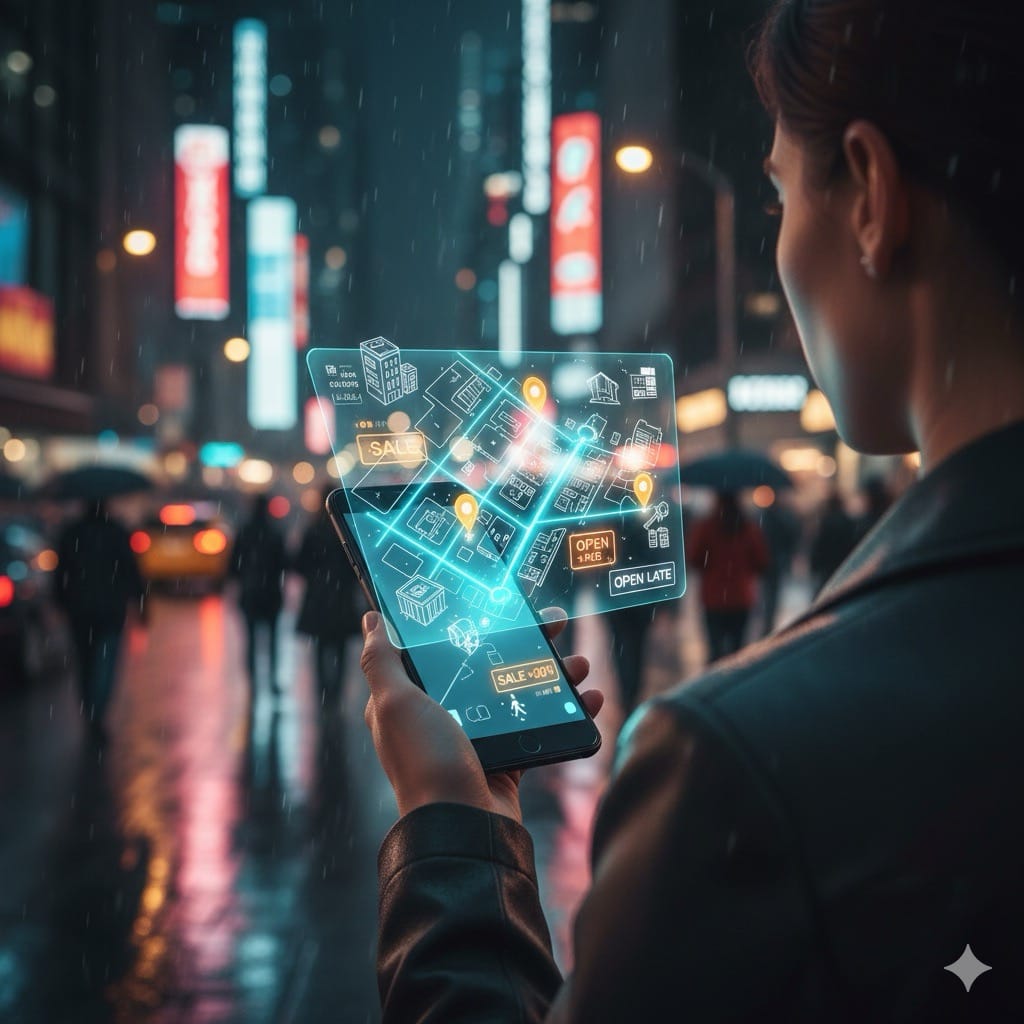
Many retailers still view their branch network as a collection of static coordinates on a map. But by cleverly utilizing Location Intelligence, this shifts to a dynamic, predictive model.
How can you, as a retailer, successfully capitalize on this?
1. The Intelligent Store Locator
A simple ‘find a store’ page is no longer enough. Integrate smart APIs that not only show where you are, but also how the customer can get there fastest from their current location, including travel time and real-time parking options. Make the bridge between online orientation and physical conversion as short as possible.
2. Data-Driven Decisions for New Locations
Predictive spatial data not only helps direct customers to your existing stores, it also tells you where to open your next store. By overlaying mobility data, demographics, and competitor analysis (Spatial Analysis), you can predict expected footfall with unprecedented precision.
3. Anticipation via Weather and Traffic Data
Advanced retailers link their offerings to external spatial factors. Is there a rain zone moving across the country? Then you optimize online ads for indoor shopping at your branches with large parking garages, right at the moment consumers are changing their plans.
The Map is the Interface of the Future
With the rapid rise of Generative AI in search queries (GenAI Places Search), the map is increasingly becoming the primary interface between consumer and retailer. Searches are becoming more complex: “Where can I park right now and buy an umbrella within walking distance?” Only organizations that have their location data strategically organized will be recommended by these new AI models.
Ready to Take the Next Step?
Google Maps isn’t just a map; it’s a powerful engine for data-driven retail. At Localyse, we help organizations put these spatial puzzle pieces together, so you no longer have to guess where your customer is going, but are simply already there to welcome them.
Ready to optimize your Location Strategy? Let’s talk.


