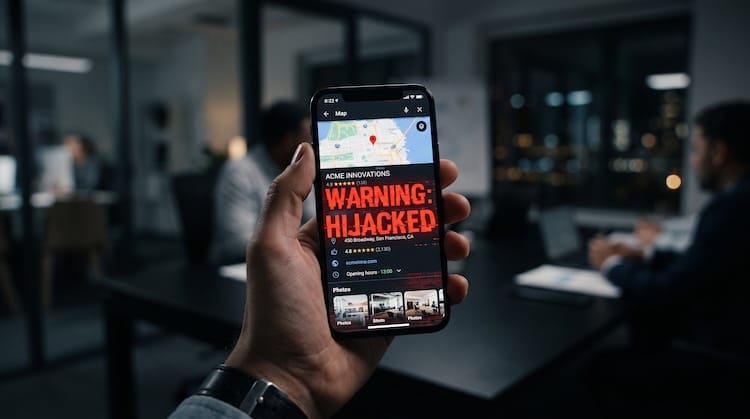

People blindly trust the information provided by Google Maps. That trust is the foundation for thousands of physical visitors, online conversions, and brand loyalty. But what happens when malicious networks hijack your company’s digital front door? A recent wave of digital hijackings via fraudulent ‘Local Guides’ proves that managing Google Maps is no longer just a simple SEO task. It is critical reputation management.
Over the past few weeks, a disturbing trend has emerged on Google Maps. Both in the Netherlands (Amsterdam, The Hague) and internationally (Brussels, Berlin), legitimate business profiles are unwittingly becoming digital billboards for illegal activities and fraud.
The Modus Operandi: AI Photos and Telegram Links
How do these networks operate? Using fraudulent or hacked ‘Local Guide’ accounts, criminals upload AI-generated photos to existing Google Business Profiles. These photos, which are often prominently displayed by Google’s algorithm, contain text with a direct link to a Telegram group.

Visitors who follow the link end up in shadowy networks where illegal drugs and other illicit substances are traded. Localyse’s own data analysis shows that these illegal photos generate tens of thousands of views in no time. The fraud is now so widespread that competing spammers are overwriting each other’s fake photos and openly arguing on Google Maps about who the ‘real’ dealer is.
Not Just Retail: A Broad B2B Risk
While the media primarily focuses on the impact on CBD shops and coffeeshops, the danger extends much further. The unauthorized modification of location data affects every sector:
1. Real Estate and Project Development
A recent example in the real estate sector painfully illustrates this vulnerability. For the new construction project ‘SAM’ in Zoetermeer, all official channels—from the real estate agent and the builder to the main housing platform—correctly linked to the project website. However, the domain registration had silently expired and was immediately hijacked by an Indonesian online gambling syndicate. Visitors blindly trusted the link simply because the referring sources appeared legitimate. The reputational damage for a multi-million euro project like this is enormous.
2. Financial Services (Banks)
For banks and financial institutions, this risk is potentially even greater. They actively direct their customers to secure, digital channels and aim to minimize unplanned physical branch visits. Trust is the absolute foundation here. If a malicious actor manages to change the phone number of a local branch via Google Maps, or adds a phishing link to the profile picture, customers can easily fall into a scammer’s trap.
The Illusion of the ‘Autopilot’
Many businesses and local governments mistakenly assume that their location data, once entered, is safe. The reality is that platforms like Google Maps are dynamic; they rely heavily on user-generated content and crowdsourcing. Anyone, from a well-intentioned visitor to a malicious Local Guide, can suggest edits or upload photos.
Without active monitoring and proper data security (claiming and verifying profiles, and automatically rejecting harmful updates), your company’s digital front door is simply left wide open.
Regain Control with Localyse
As a strategic partner in Location Intelligence, Localyse helps businesses and governments regain full control over their digital location data. We ensure that your data on platforms like Google Maps is verified, up-to-date, and secure, preventing you from unwittingly becoming a victim of digital hijacking.
Want to know how vulnerable your location data currently is?
Don’t leave your business profiles at the mercy of algorithms or anonymous internet users. Contact our experts for a risk analysis of your digital footprint.


